




Agrikomoditi Biojisim
Industri biojisim Malaysia.
Gambaran keseluruhan
Overview of the Biomass Industry in Malaysia
The Biomass Sector has been replaced by the 12th Malaysia Plan (12MP) as one of the eight strategic and high impact industries to regenerate economic growth.1 Malaysia is developing the potential of biomass industries in various sectors, including plantation, forestry, agriculture, livestock and fisheries industries. These sectors have been outlined as the focal areas of the National Biomass Action Plan 2023 – 2030. The Plan is mandated by the Ministry of Economy and spearheaded by the Ministry of Plantation and Commodities (KPK). The focal development of biomass industries in these five sectors has the potential to contribute to sustainable consumption and production, supporting Malaysia’s transition towards a low-carbon and circular economy with the creation of new jobs. The following is a brief introduction to the biomass industries in these five sectors:

Plantation Biomass: Malaysia is known for its vast plantations, particularly oil palm and rubber. Biomass generated from these plantations can be utilised as various value add products. The plantation sector offers abundant biomass resources that can be harnessed for bioenergy generation and bio-materials production. The plantation biomass sector provides huge circular economy opportunities.
Forestry Biomass: Malaysia possesses rich forest resources and the forestry sector offers significant potential for biomass utilisation. Timber industry residues can be utilised for bioenergy production including heat and electricity generation. Wood waste can also be transformed into value-added products like wood pellets, medium density fibreboard (MDF) etc. The sustainable management of forestry resources ensures responsible biomass extraction and at the same time preserving forest ecosystems and biodiversity.
Agricultural Biomass: Malaysia’s diverse agricultural sectors generate substantial amounts of byproducts and waste materials. Agricultural residues can be converted into biofuels, carbonised products or used for heat and power generation. Agricultural residues can also be processed into organic fertilisers or animal feed. The utilisation of agricultural by-products for biomass industries can help reduce waste, promote resource efficiency and create additional revenue streams for farmers.
Livestock Industry Waste: Malaysia has a thriving livestock industry. Livestock wastes, such as poultry manure, swine slurry and biogas from anaerobic digestion can be utilised as sources of renewable energy. The utilisation of livestock wastes for energy generation not only reduces greenhouse gas emissions but also offers an opportunity for waste management in livestock farming.
Fisheries Industry Waste: Malaysia’s coastal and marine resources support a vibrant fisheries industry. Fisheries by-products can be processed into fishmeal, fish oil or hydrolysed for the production of bioactive compounds and liquid biofertiliser. Utilising fisheries by-products can reduce waste in the fishing industry and create additional economic opportunities.
Out of all these five sectors, oil palm biomass remains Malaysia’s primary biomass resource. The country has an estimated total of 5.67 million hectares of oil palm plantations, producing more than 90 million tonnes of dried palm biomass.2 Oil palm biomass is derived from a variety of oil palm byproducts, such as oil palm fronds (OPF) and oil palm trunks (OPT) from plantation operations. While empty fruit bunches (EFBs), palm kernel shells (PKS), mesocarp-fibre (MF) and palm oil mill effluent (POME) are generated from the milling operations. The oil palm biomass industry has been growing at a steady pace over the past few years, thanks to the interest and transition towards using lowcarbon renewable energy. Based on the data of 2019 compiled by the Energy Commission, Malaysia has achieved a total installed capacity of 440.5 MW powered by biomass including 70.65 MW coming from grid-connected power plant which is equivalent to 1.2% share of total electricity generated in Malaysia with a total emission reduction achieved i.e. 395.22 Gg CO2 eq.3 Hence, bioenergy can be used to decarbonise our electricity supply through dedicated action plan.
The Malaysia Government has acknowledged the significant contribution of biomass resources towards achieving our nation’s Sustainable Development Goals (SDGs). This acknowledgement comes in the form of various incentives and supports provided by key government agencies such as the Malaysian Investment Development Authority (MIDA), Malaysia Palm Oil Board (MPOB), Sustainable Energy Development Authority (SEDA), Bioeconomy Corporation, Malaysian Green Technology & Climate Change Corporation (MGTC) etc.
The biomass industry in Malaysia has shown tremendous growth potential in the last decade or so. We are now producing and exporting solid biofuels such as palm kernel shells and wood pellets to key markets of Japan and the Republic of Korea. The biofertiliser sub-sector has also been growing to meet the demand for sustainable farming using EFBs, POME, chicken dung, fish waste, woody biomass etc.
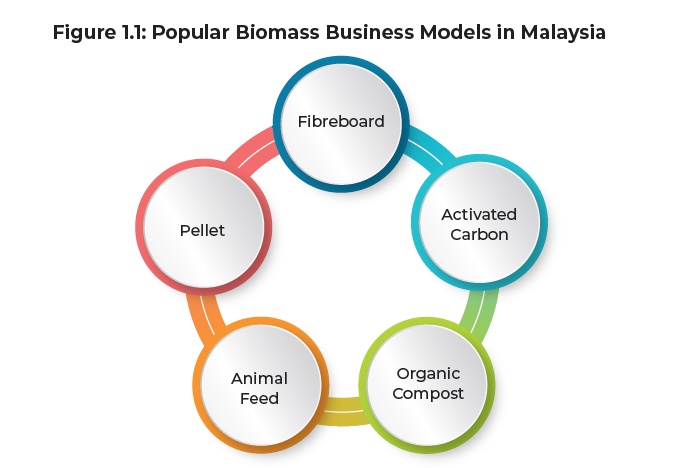
More focused efforts are needed to ensure that the economic harnessing of our biomass resources is aligned with the concept of Circular Economy. Such efforts include close engagement and coordination between government and industry, development of effective policy and action plans, collaboration between industry and academia, facilitation to access biomass feedstock and financing etc. According to MIDA website, the most popular bio-based products manufactured in Malaysia are as follows:
For any inquiries, please email:
Setiausaha Bahagian
Bahagian Biojisim dan Biobahan Api (BBA)
Kementerian Perladangan dan Komoditi
No. 15, Aras 5-13,
Persiaran Perdana,
Presint 2,
62654 Putrajaya, MALAYSIA
Emel : bba [@] kpk.gov.my